

Matt Trease
is a poet, artist, teacher, and astrologer. He serves on the board of the Cascadia Poetics Lab, co-curates the Margin Shift reading series, and serves as the poetry editor for the CAELi Review. His poetry has appeared in numerous journals and anthologies. He is the author of The Outside (forthcoming Carbonation Press, 2024) and the chapbooks Later Heaven (busylittle1way designs) and rcvrdtxt (rlysrslit). He lives in the Salish Sea region of Cascadia on the homeland of the Duwamish people with his partner Xan, his son Harvey, and their dog, Hoopla. Find out more @ https://bio.site/mjtrease.
thinkingwith: writing strategies for reconnecting to earth
Our current media landscape seems hooked on a doom loop, an apocalyptic dream of human self-annihilation from collapsing nation states and anarchy to climate change to AI terminators, to genocidal warmongering. In order to avoid going down with that ship, we, as humans, are going to need to flip the script, to learn to think differently.
This lab will focus on writing strategies, applicable for poetry or prose, for breaking the spell that objectifies and cuts us off from the earth and from place and all the living beings that we (often) obliviously live in relationship with. We’ll do that by intentionally widening the socially-imposed conventions of “normal” perception via some minor alterations to our daily writing practices.
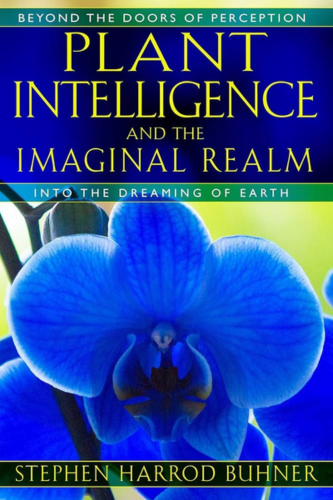
As a trail guide in this 5-week excursion, we’ll read through the first section of Plant Intelligence and the Imaginal Realm: Beyond the Doors of Perception into the Dreaming of Earth by the late herbalist and self-described “Bardic Naturalist” of the Gaian movement, Stephen Harrod Buhner as well as writing by Goethe, Gertrude Stein, Francis Ponge, Will Alexander, Bernadette Mayer, Italo Calvino and more.
Sundays 3-5:00 PM Pacific Time
February 15, 22, March 1, 8, and 15, 2026
Cost: $125.00
*Note: Canadian registrees: if funds are tight, you can pay the CAD equivalent. Please reach out via the contact form.
 Order a copy of Plant Intelligence directly from the publisher, Inner Traditions
Course Materials Week One
(Sunday, February 15, 2026, 3-5 pm PDT)
Read the Lab Notes and what you can of:
- the Prelude of Plant Intelligence (here’s a pdf in case you’re still waiting for your copy)
In the zoom, we’ll discuss each of your thoughts and ideas about plant intelligence, what landed for you in Buhner’s opening argument, and engage in a quick writing exercise to get us thinking outside ourselves.
And here’s some supplemental material to glance at (and maybe draw on for a future lab)
- Poems/Essays by Gertrude Stein – “A Grammarian”, Tender Buttons, and “Composition as Explanation” – and Lyn Hejinian – an excerpt from My Life
- Journals by Henry David Thoreau and Johan Wolfgang Von Goethe
Watch:
The Secret Life of Plants, a mind-bending and beautiful documentary from the late 1970s
Listen:
Stevie Wonder’s Journey Through the Secret Life of Plants
Recording of Zoom Session for Feb 15, 2026
Course Materials Week Two
(Sunday, February 22, 2026, 3-5 pm PDT)
Read:
- Lab Notes for Week 3 (Posting on 2/15 at 6pm)
-
Chapters 1-3 of Plant Intelligence (here’s a pdf in case you’re still waiting for your copy)
-
Essays by Georges Perec – Species of Space and Other Places and An Attempt at Exhausting A Place in Paris
-
Prose poems by Francis Ponge
-
an online anthology of Francis Ponge with English Translations
-
Joshua Corey on Translating Ponge and excerpts (Note: this translation is now out of print)
-
Translator’s Note and excerpts from The Nioque of Early Spring and more excerpts
-
-
Flash Fiction and Lectures by Italo Calvino Mr Palomar in the Garden and Six Memos for the Next Millennium
-
Prose poems by Harryette Mullen S*PeRM**K*T
-
Clark Coolidge The Crystal Text
-
Jacques Derrida’s attempt to try to understand his cat, The Animal That Therefore I Am
Watch:
John Berger’s 1972 4-part BBC series Ways of Seeing
Listen:
Check out this Spotify Playlist Music for Plants
Write:
In discussing how to widen our sensory perception, Stephen Herrod Buhner notes that the most important step is merely being intentional, so that’s what we’ll do. We’ll also take some cues from Claude Monet and Clark Coolidge to treat this as an ongoing practice, not meant to self-improve or perfect a technique, but more like a spiritual practice.
First, find a non-human entity to thinkwith – a house plant, a pet, a haystack, a building, an intersection, or even a crystal. Don’t sweat what it is. Think of it like a first date – it’s likely not going to be perfect, but you may both get something out of it. That said, it should at least be something you can be in real physical space with.
Each day, spend some intentional time with this entity (even if it’s just 5-10 min). Journal through your experience, taking notes. Try to be thorough, and it’s ok to use sentence fragments and lists.
One way to start opening up your sensorium is to shift your attention to a particular sense. One day you might try to exhaust your visual sense of the thing. The next day, switch it up and try to hone in on what you hear, then feeling/touch, smell, taste, and so on. Try to push yourself beyond the basics. keep taking notes until you encounter a surprise. On Sunday, we can talk as a group about what you learned from your non-human collaborator.
Recording of Zoom Session for Feb 22, 2026
Course Materials Week Three
(Sunday, March 1, 2026, 3-5 pm PDT)
and here’s some samples of different approaches to collage (read whatever draws you in)
-
Ronald Johnson, ARK (uncorrected edition and Stephanie Burt’s review of the corrected edition)
-
Paul Nelson, Daysong of Thoughtless Openness (video of poem read aloud with text)
-
Hannah Weiner, Clairvoyant Journal (an experiment in dictating Clairaudient experiences)
-
Brian Teare, Sight Map (collaged text responding to the minimalist “sculpture” work of Robert Smithson and in conversation with Emerson and Thoreau)
-
Robin Blaser, Pell Mell (collages in and dialogues with Philosophical texts. Note: Robin was a professor of Philosophy at Simon Frazier University in BC)
-
Layli Long Soldier, Whereas (dialogues with a US apology to North American Indigenous peoples buried in an appropriations bill and other legal tribal documents)
-
Ted Berrigan, Bean Spasms and The Sonnets (both are primarily collage assemblages)
-
Bernadette Mayer, Midwinter Day (a poem composed spontaneously on December 22, 1978. Here’s interview excerpts of her discussing it)
Watch:
Michael Levin, All Intelligence Is Collective Intelligence
Annaka Harris on The Mystery of Consciousness
Rupert Sheldrake on Why the Mind Is Not the Brain
The Beauty of Bacteria | Discover The Microcosmos INSIDE You | FULL DOCUMENTARY
Listen:
Check out this episode of the LifeWorlds podcast with Paco Calvo, Spanish Philosopher and Scientist investigating Plant Intelligence
Write:
If we’re going to take thinkingwith and collaborating with nonhumans seriously, we have to start to make some space in our writing for the non-human to be able to contribute. As someone whose practiced astrology and forms of divination like Tarot and Bibliomancy (divining from books) for years, I can think of no better technique than collage to help do that. Collage, as a writing practice, works by cutting and pasting found text into a poem, story, etc. Since the found text is not one you composed, it can help you to distance yourself from the idea being expressed. For this exercise, try to spend some time each day with the non-human you observed last week.
This time, bring a book with you. Something completely random is best (so you are less tempted to manipulate what comes out). Start reading a portion of the text (you can begin at the beginning or pick a random starting point). When you encounter a statement or phrase that resonates with you, write it down. As you do that, pay attention to your own thoughts and observations. If your thoughts start to respond to or build on the quoted text, write that thought down as if you were having (or relaying for a reader) a dialogue. Keep moving through your text, collaging, and responding, until your session is up or you reach the end of the passage. This may seem rather odd, but what you’re doing is training your mind to listen to what signals may be coming in from whatever is around you instead of trying to control it with a metaphor or pre-packaged picture.
Recording of Zoom Session for March 1, 2026
Course Materials Week Four
(Sunday, March 8, 2026, 3-5 pm PDT)
and here’s some samples of poetry and prose that highlights the patterns that connect:
Allison Cobb: early version of Plastic: an autobiography
Erin Hobbie, The Orange (and the main source of quotes John McPhee’s Oranges)
Oni Buchanan, The Mandrake Vehicles
bp nichol, Zygal
Mei Mei Berssenbrugge, A Treatise on Stars
Peter O’Leary, Phosphorescence of Thought (excerpt)
Juliana Spahr, “Gentle Now, Don’t Add to Heartache” , an excerpt from The Connection of Everyone with Lungs
Watch:
Nora Bateson, An Ecology of the Mind (documentary on Gregory Bateson)
Listen:
Sturgill Simpson, Metamodern Sounds in Country Music
Write:
Toward the end of The Metamorphosis of Plants, Goethe notes that the circularity of development and metamorphosis makes it impossible to describe the (Platonic) meta-form,
“the standard against which to compare the various manifestations of it’s form. For the present, however, we must be satisfied with learning to relate these manifestations both forward and backward. Thus we can say that a stamen is a contracted petal or, with equal justification, that a petal is a stamen in a state of expansion; that a sepal is a contracted stem leaf with a certain degree of refinement, or that a stem leaf is a sepal expanded by an influx of cruder juices.
We might likewise say of the stem that it is an expanded flower and fruit, just as we assumed that the flower and fruit are a contracted stem.”
If the Universe is indeed a series of nested self-regulating systems, than we should expect to see these types of metamorphic “backward and forward” types of relationships. so let’s look for them. Spend some time with your non-human subject/collaborator. Try to describe “it” the way Goethe suggests. Don’t isolate the parts (i.e. don’t verbally pull it apart to reverse engineer it), but focus on the chain of relationships – describe the leaf in terms of the stem and vice versa. Keep in mind that if you scale out or in you’ll start to see that those relationships extend beyond your pre-conceived subject and at some point include you as well. If you can follow the chain until you find yourself in it.
Recodoring of Zoom Session for March 8, 20206
Course Materials Week Five
(Sunday, March 15, 2026, 3-5 pm PDT)
and here’s some samples of poetry and prose that relate to Buhner’s concept of Nature’s baked in psychedelic functions:
Gabriel Gudding: The Rhode Island Notebook (excerpt).
Gabe wrote this book spontaneously by hand in his car driving back and forth between Rhode Island and Illinois
CA Conrad’s (Soma)tic Poetry Exercises (Course packet from upenn). These are great examples of creating ritualized experiences with things like a rose quartz or the color red and creating poems from the notes of the experience.
-
And on a stranger note, you might look at how the abstract language of science and philosophy distort our perception and how misapplying them can have a type of psychedelic effect. Will Alexander does this exquisitely. Check out Poetry Magazine’s November 2022 Dossier on Will: Poet as Spectrometer
-
Johannes Göransson, Introduction
-
Will Alexander
And keeping in line with how Buhner discusses the role of fungi, check out this amazing book from contemporary Swedish Surrealist Aase Berg, who looks closely into the decomposition of living matter for it’s fecundities.
Aase Berg, With Deer
Watch:
Tyler Volk: Metapatterns: What is a Sphere? Water Lily & Wine Glass ABCDNAlphabets
1950s LSD Experiments with LSD:: Housewife interview Young Woman Interview CBS Special on Spring Grove Experiment Pt1 and Pt 2
If you have time and Netflix, check out Michael Pollan’s How to Change Your Mind (Docuseries)
Listen:
Life Worlds Podcast: The Ecology of Health Speculative Design & Embodied Imaginations
Write:
In in the preface to his book, Metapatterns, Tyler Volk writes:
Suppose you were asked to define a canoe. You describe a canoe’s shape, its dimensions, material, ever methods of construction as if preparing to build or at least to recognize one. In another type of answer you might describe what a canoe does, how it functions, namely, carrying a person across water. Perhaps in this case the listener might need to use the canoe.
There is yet a third way of responding, Rather than saying anything directly about the canoe, you describe the experience of being in a canoe, what can be seen while paddling around perhaps creeks tumbling from forested gorges into a secluded lake.
Try describing your non-human collaborator via your experience of it, much like Tyler Volk’s third way – by detailing your experiences from being around it/them.
Alternatively, you might try looking into other descriptions of your subject collaborator (like looking the plant up in a field guide, preferably some kind of scientific text. Use the language in that text to describe other things in the space, so as to see your nonhumans’ metapatterns all around you.
As part of your registration, you become a member of Cascadia Poetics LAB. Membership is free, carries no cost or obligations, and is recorded with your registration. See our Membership Policy for details.