

Notes
Week Five
for Sunday, October 05, 2025
The End of the Line
In the winter of 2011 – 2012, I was living in Chicago and going through the process of a divorce. I had been writing poetry for over a decade at that point but was hitting a wall with my writing. It all felt so cerebral and intellectual and disembodied. In hindsight, I was experiencing all this grief of the end of a life I had been building, and words just felt so inadequate, like I had hit the margin of the page. Coincidentally, a non-poet friend at the time, nudged me to me to try out this new square format camera/social media app that was mostly visual artists and photographers posting photo challenges and sharing results. This was before Instagram was bought out by Facebook and turned into another marketing tool for self-commodification. I got hooked on the platform, and before long I was scouring my neighborhood almost daily, noting and observing and experimenting with my visual sense that had been somewhat dulled by the conceptual modes of writing that were the big poetry trend at the time. The nonhuman world around me began to burst with life, and I could feel that Outside life churning, composting my own grief. My life was turning like the line of a poem.
A year later, I picked up poetry again, bringing all that aliveness of attention back with me. Often when we get fixated on a project or an idea, the signal suddenly gets lost, garbled by the challenges of our living and we need something to disorient our fixation so that we can find that spark, that surprise, that just like a good line break, turns us back on the path the poem is making.
Eilene Myles talks about this in her short essay “How I Wrote Certain of my Poems” from her book Not Me, how the poem is like the universe nudging us toward revelation after revelation after revelation, each one a bit more expansive that before. In this sense the real poem, like Allan Kaprow’s “real experiment” never ends; it just keeps turning, reincarnating to a new line, a new stanza, a new sequence, a new book, etc. In that sense, discrete poems and books are like little frames or cabinets (ala Eileen’s description in more recent interview with Maggie Nelson) not unlike Joseph Cornell’s little boxes, little episodes in an ongoing radio serial drama (or sit-com, depending on your take).
For this week:
Try your hand at turning the line, so to speak. Take 1-3 (or more if you have time) of your poems or ritual notes and sit down for a 2nd pass at it. Don’t think of this as editing or polishing, but a re-visiting or re-turning the piece like you’d turn a line. You might try bringing a different tool or process to the poem. If you started with bibliomancy, maybe try bringing in ritual, or a Surrealist game. If it’s a ritual note, maybe try copying the note over, and using Bibliomancy to bring in other material. Just go with your gut. It’ll tell you what you need to do next. We’ll review those 2nd passes in class next week and talk about thoughts or ideas each of you have for what you might do post-lab, how you might (or not) incorporate some of the tools or practices we’ve talked about during this 5-week lab.
For me, and you don’t need to replicate this, I tend to use Bibliomancy as a first pass of most poem(s), but sometimes I’ll start with ritual and notes and then move on to Bibliomancy. I’ll have like 20-40 sources sorted into piles that I’ll assign a court card from a tarot deck to. I’ll shuffle the cards, focus on a word or image, and pull a card. The card will tell which pile to grab from. I’ll grab from there, find a random page/line, and write it down and then repeat. My first drafts almost always start in a composition book with a pencil. I’ll go until I hit a line that seems like a last line of a poem or until I hit the end of a page. I try to make the page a hard cut-off, because I know I’m coming back to this. Often, I’ll get all these little interruptions throughout that don’t appear to fit the poem but are telling me they belong (these are usually free associations I have). I will jot those in the margins and save them for a second pass.
I often do like 30-60 poems or pieces in a batch and do 1 (maybe 2 if I have time) a day, so by the time I’ve gotten through the batch, it’s been close to a month since I started with the first one. That’s a pretty good pause to disrupt any ego-meddling with the poem, so I’ll start a second pass.
During the first pass, there’s usually a song or a lecture or a book or an idea/topic that was missing the first time around (sometimes I note it in the margins of the notebook during my first pass). This also sometimes shows up synchronisticly while writing. One time I was channeling a poem and while I was dictating a line that referenced a crystal, I got a notification on my phone that a book I had ordered had been delivered. It was the reissue of Clark Coolidge’s The Crystal Text. That definitely caught my attention! I paused my process, went to the mailbox, got the book, and started using it immediately. The poems started opening up to something new right away like I’d walked from a small foyer into a much larger room. Regardless of how the sources come to me, I take note, and make sure to use them.

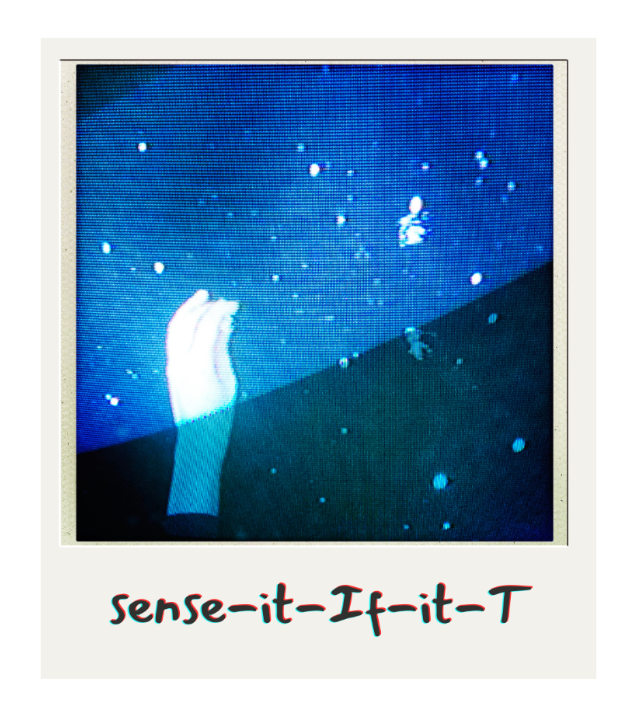
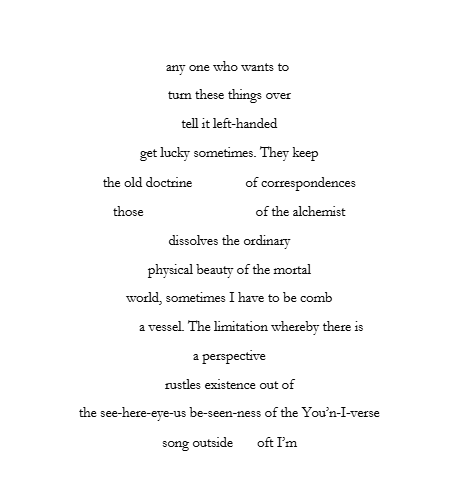
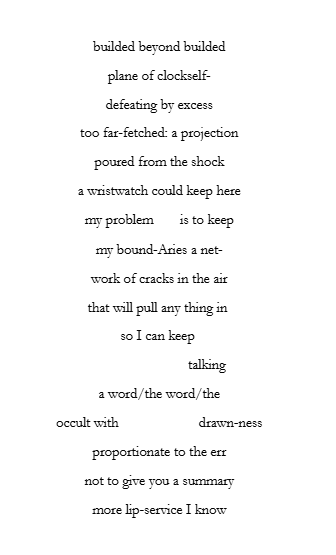
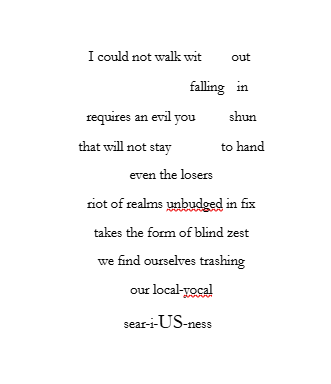
Two passes of an unpublished poem “sense-it-IF-it-T”
On my second pass, I still work with paper and pencil, but I’ll grab a somewhat bigger sheet. I’ll (try to) read the handwritten mess like it was a poem. The rhythm and line breaks will always lead me to where something is missing. I’ll have those missing sources on hand and probably a song or a talk streaming in my ear (like the Illot Mollot Surrealist game). If the missing line doesn’t jump at me, I might pull a tarot card to tell me which source to use. By the end of this pass, a path is almost always emerging. It’s not in a computer doc yet, so there’s still another pass to make to type it out, so I’ll repeat the process but usually with only 1-2 additional sources. Here’s how it looks in a Word doc:


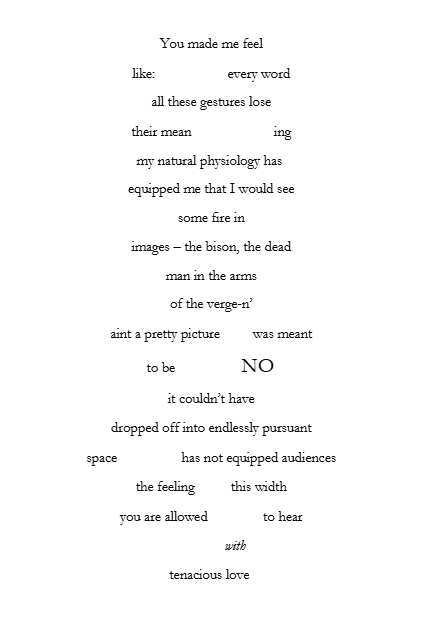
By that point the form of the poem is taking shape and it’ll be ready for some minimal proofreading or editing (never polishing!!!!) when it gets to be time to put a book together.
Listen: In 2018, St. Vincent recorded a follow-up to her wildly popular MASSEDUCATION (2017) that was like a 2nd pass, re-recording the same songs but with altered arrangements and acoustic instruments. Take a listen to how the 2nd pass, MassEducation (2018) opens up the songs and album and make room for a new range of emotional response.
Week Four
for Sunday, September 28, 2025
an Extreme Present
There’s a point in Mel Brooks’ hilarious 1987 anti-colonial parody of space fiction, Spaceballs, where the villains, Dark Helmet and Colonel Sanders have lost track of the protagonists they are chasing (Lone Star and friends in their flying Winnebago). When radar tracking fails them, suddenly, in one of the many nods to the 4th wall and the Hollywood studio apparatus, Col Sanders turns to a Corporal and says “get me a cassette of Spaceballs the movie.” They then proceed to scan the movie to find their targets, until the Corporal stops the tape revealing what for the characters is the “present moment.” Dark Helmet, taken aback by the uncanny valley of infinite regression they’ve entered begins testing the video much like a mirror and turns to the audience and asks, “What the hell am I looking at?” to which Col Sanders responds in true mechanical military tone, “We’re at Now now. Everything that’s happening Now is happening now.” This further disorients Dark Helmet and the two being to have a bit of a Laurel and Hardy moment of deciphering the relationship of past, present, and future.
I bring this up for a couple of reasons. First, it’s a quite humorous send up of how late capitalist economy both imagines and projects a concept of time that is so linear and predictable that you can have “instant cassettes – they’re out in stores before the movie is finished.” If that sounds a lot like current conversations about AI, it should. A recent season of Black Mirror took up something like this idea in the episode “Joan is Awful” in which an AI uses digital facsimiles of celebrities to instantly transform events in real life into soap operas.
The second reason I mention the Spaceballs clip might help to lay out a notion of time and experience that can serve as a counter to commodified linear time. I bring up the clip because in 1988 when I first encountered the film, I was going through a bit of an existential moment not unlike Dark Helmet.
When I was a young kid (say around 6), my parents moved from rural Ohio to Nashville, and within months of moving they had converted from a very waspy Methodist version of Christianity to something far more rigid and authoritarian. My dad stopped drinking, smoking, and playing music, and we were in church 3-5 nights a week or drug out hear preachers tell people on the street about how they were doomed to a life in hell. The pastors at the church we attended talked about how Satan had corrupted the natural and political world, and how Jesus wanted us to dominate and subdue it (include our human nature) to help build a theocratic kingdom that might usher Jesus back (so that he might annihilate our “enemies”).
In 1988, many of the men at our church began listening to a paranoid Christo-fascist and former NASA astronomer who was predicting that “the rapture” would happen on Rosh Hashanah that year (roughly around Sept 11). The reasoning relied heavily on understanding cycles of time, which in some ways was at odds with the strong underlying desire to escape into the linear time of the market. But the cognitive dissonance was quite strong in those circles. So many of my friends and I on the verge of adolescence, were subjected to weekly and sometimes daily “prophesy” talks about time cycles and how the world was ending, all to make sure we weren’t “Left Behind” as a later set of Rapture novels and films put it. It never surprises me when I reflect on how many of us in that culture later came to struggle with mental health issues.
Side Note: from 2016-2020, I took whiteout to a high-quality scan of the book, making a book-length meditation on time, sound, and mysticism. There’s a handout about the project on the CPL Website, but here’s a few sample photos:
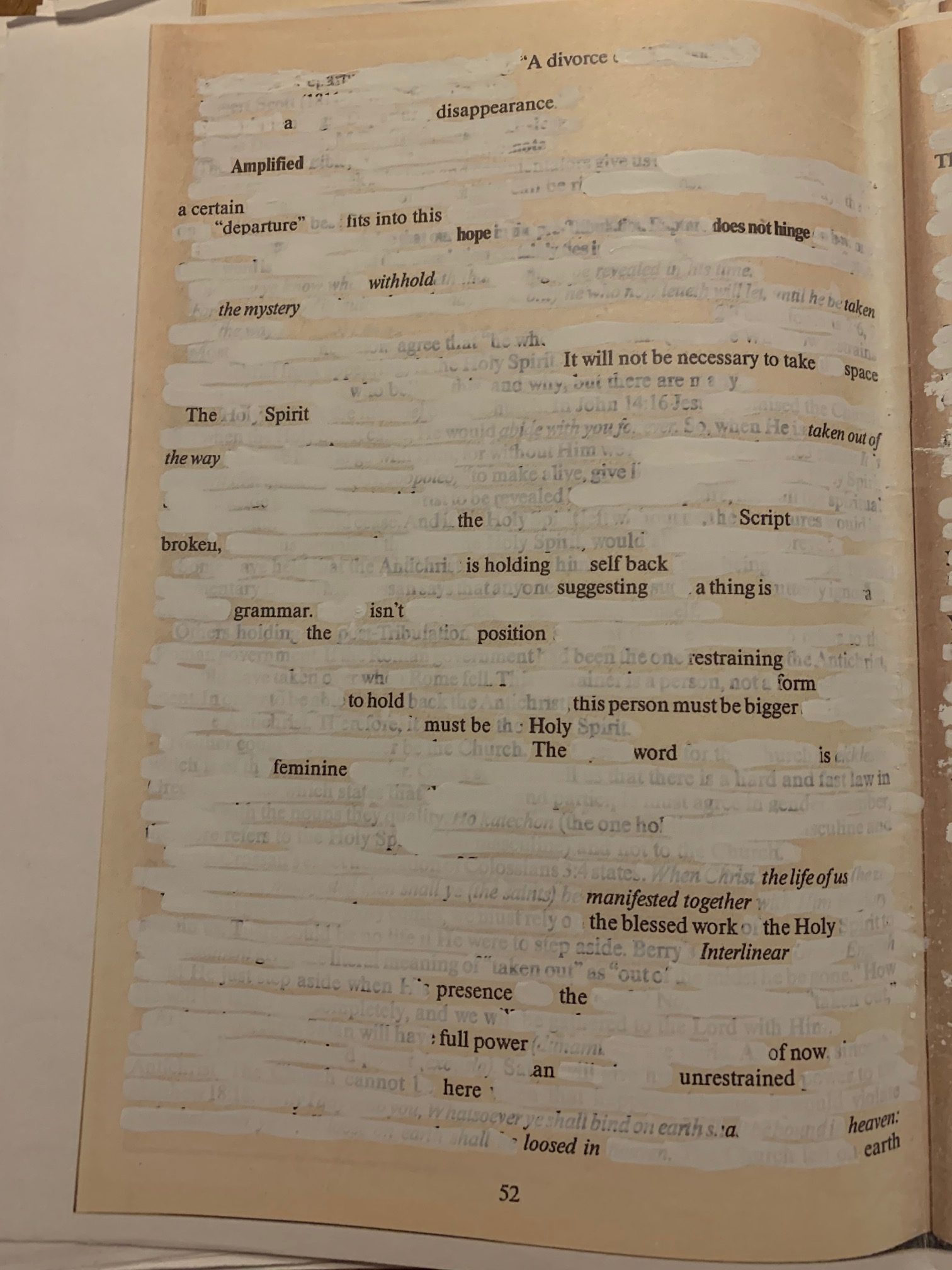


Needless to say, the rapture those men were so sure of didn’t happen. Many of them had to go back to their bosses and eat crow because Jesus didn’t take them away forever. Things quieted down for a few years after that. But in many ways, for me, the world as I knew it really did end that Fall, because despite the emotional and spiritual abuse, I held to a secret desire – I wanted the world, replete with its nested and confusing cycles, to keep going; because I knew deep down that there is life there and I didn’t want to escape to timelessness and vindictiveness.
It was in that end-of-the-world context I encountered Dark Helmet’s existential moment, which I connected with far more deeply than I could have fathomed at the time. Now whenever, I’m facing a dilemma which triggers a desire to escape to fantasies of the past or future, I hear in the back of my mind an echo: we’re at Now now, and every time that happens it means something new because the context has changed. It’s as if that memory were a specter haunting the present, a trace or negative bleeding through (as in double-exposed or blended images or like samples in hiphop or digital mashups), or as though, as Ezra Pound noted in the opening of The Spirit of Romance, “All ages are contemporaneous.”
This is what I find so powerful about poetry – that past and future are wound up in the present like the strings of a piano, guitar, cello, etc. When those memories and premonitions get triggered, they sound a note in the mind and when you tune your ear or body to it, you create the conditions in which it’s possible to enter the song, to co-create the melody and improvise. [If that interests you check out the CPL workshop on Robert Duncan’s HD Book]
Part of how we do that is by situating ourselves in time and place, which is not the same as being descriptive of the landscape (though landscape can be a part of it), but more like what we might do in a journal with a time and location stamp. But before coming up with a gimmick or template for that, you might begin by asking “What the hell am I looking at?” Like in this note I wrote for the class last year:
Nov 23, 2024
Outside my window as I write these notes, the crows along this stretch of the Green River are beginning their morning murder debrief. Living along a high ridge now (we recently moved to this portion of the West Valley a few months ago), I’m beginning to notice things about my local environment I didn’t have the perspectival vantage point to sense out before. I’ve read about this social aspect of crows in the abstract but seeing it within a stone’s throw is quite mind altering. If you’ve never witnessed this, imagine something between UK PM Question Time and Alfred Hitchcock’s The Birds. I am noticing how my consciousness is slowly beginning to open to this new aspect of neighborhood activity.
In cosmic news, this past Tuesday (Nov 19, 2024), Pluto entered a section of Earth’s ecliptic (our annual path around the sun) it hasn’t traversed since the end of the 18th century. That last time we were similarly aligned with this (dwarf) planet (1777-1798), humans were unaware of its existence, though a musician and moonlighting astronomer paying close attention to the constellation Gemini did extend our senses enough to realize there were more “wanderers” beyond the rings of Saturn. Next Summer, if you manage to escape the light pollution, and you open your sense perception just enough, you, like William Herschal, might catch against the backdrop of those cosmic twins, another extremely rare sighting of that planet, originally named for the “mad” British monarch, whose manic mood swings left room for grifty politicians to mask their financial malfeasance by over exploiting their colonies in North America, sparking the first of a series of revolutions in France, Haiti, and Latin America over the next 2 decades.
These events may seem disconnected, but both are part of locating experience in time and space. The one may seem more concrete and the other too abstract, but that’s an illusion. In this age of reductionist mechanized science, we’re conditioned to think of space as empty, floating rocks as inert and lifeless, and disconnected from life on Earth. Coincidentally (or not so), that worldview came into prominence the last time we were in this same spatial relationship to Pluto and Uranus. If you find the correlation of collective human behavior with planetary cycles fascinating, you might take a look at Richard Tarnas’, Cosmos & Psyche (You can get a teaser for it with this podcast interview with him on AstrologyHub) and maybe start tracking time a little differently, like returning to a pre-18th century practice of using an almanac to track your own busy schedule with the lunar and planetary cycles.
But back to Now now.
Because the point of all this is not to put our memories into little boxes (unless they’re of the Joseph Cornell variety). It can be tempting to locate the spacetime of an event just so that you can pin it to a neat linear timeline of your path to Enlightenment. Like how most people read Robert Frost’s “The Road Less Traveled,” in which “two roads diverged in a yellow wood” yadda yadda yadda “I took the one less traveled” [add dramatic pause] “and THAT has made all the difference.” Never mind Frost said numerous times that the poem was mocking sappy notions of determinism, like what’s expressed in this 2010 Ford commercial for instance.
Even when it’s not coming as a heavy dose of inevitable consumerism, the linear time of progress has the tendency to shut down complexity into simple cause/effect scenarios that smooth over the sheer strangeness (and also the deeply interesting aspects) of our lives. A better way to think about what we call “the present moment” may be that it is like a Russian doll or an infinite series of nested boxes. I remember once trying to write an ekphrastic poem from the David Cronenberg film “After a a History of Violence” that fell flat, but it had a line about a Chinese Magic Box concept of time, so I tried re-writing the poem AS a nested doll and that’s when things really got interesting. That poem may long have been heaped in the scrap pile, but I’m still unpacking that magic box in nearly every poem I write. This snippet of an interview with quantum physicist Richard Feynman unpacks a little bit about Why that is.
If we stop relying on cheap comparisons and quaint explanations things get extremely complicated but also WAY more interesting really fast. We encounter, not a timeless unchanging universe, but a perpetual song, a You-N-I-Verse, a Never Ending Story that resists explanation and is still full of mystery. It becomes a paradox as in in Argentinean Surrealist Jorge Luis Borges’ , a “Garden of Forking Paths” or a riddle like a Gordian Knot.
But if we cut that knot and let go of control and get “in time” what we’re stretching, bending, and at times breaking free from is not time itself, but our canned expectation of it. The Industrial Revolution conditioned western societies to think of time as objective, operating independent of material reality, but that is a relatively new story we’ve been telling ourselves.
The time measured by our phones and computerized clocks was invented in the 19th century to make railroad shipping more efficient. Before that, time of day was measured by geo-centric spatial relationships (particularly, the earth’s relationship to the Sun and Moon). This gave time a very visceral property that kept people grounded in their bodies’ spatial awareness, which in turn made them less malleable and less predictable. You might take stock of how your body reacts to shifts between “daylight savings” and “standard time,” as if it were trying to tell you that something is off. It is. When in 1918, Ezra Pound challenged poets “to compose in the sequence of the musical phrase, not in sequence of a metronome” he was reminding us that mechanical time is no longer aligned with the rhythms of life. Measured time is but the trace of a singular movement, but time is far richer and indicative of shifting and changing relationships, the mysterious force that propels life, that gives it animate properties.
Further, we can inject past and future together into a moment of time. Spontaneous composition is one way, divination another. Let’s not forget listening to the body too. The body is a great energy hub that can be brought into time with the mind through ceremony and ritual.
So how do we cultivate a practice of experiencing that crucible of time and space (what we might call place)? So much of our experience of a day is habitual, our little routines that so often run on auto-pilot so that we can get our work done and be good employees, family members, citizens, etc. One way to start waking up to life is to periodically switch off that auto-pilot. We can take a routine or habit and make it ceremonial, meaning that we engage it consciously and notice what comes up.
To that end, check out Allan Kaprow’s essay “The Real Experiment.” Kaprow was a student of Zen practitioner and avant-garde composer, John Cage and a friend an inspiration to the artists of the Fluxus movement. He was briefly art-world famous for what he called “Happenings,” in which everyday events were engaged as conscious performances. The idea was to get art out of the galleries and museums and apply it to everyday living. However, much to his chagrin, the idea was co-opted by the art world he was rebelling against, and turned into “Performance Art,” which he saw as a caricature of his intention. This is essay is from the end of his career and really gets at some great examples of how we might blur those lines.
In that same vein, take a look at Fluxus artist (and lightening rod for Beatle-fan misogyny) Yoko Ono’s Grapefruit, which is a collection of poems which are instructions for little rituals, or rehearsals for the real poem, which takes place in the mind of the reader-as-a-collaborator. It’s like a text book in how to ritualize little things in your life. Also, take a look at the online archive for Learning to Love You More, an art-as-living project by Miranda July and Harrell Fletcher, in which the artists gave volunteer participants on the internet simple assignments for having and documenting creative experiments in their communities.
You’ll also want to familiarize yourself with the work of CA Conrad, who for the last 15 or so years has been presenting their poetry in the context of what they call (Soma)tic ritual. Like this brief JUPITER HUMANIFESTO: A (Soma)tic Poetry Entrance, this basic breakdown of the practice into 3 parts, the short introduction to their book ecodevience, this course packet of CA’s rituals compiled by Michelle Taransky at UPenn, this video of a Ritual construction workshop CA gave for Mack (live) in January of 2022, and poems from their most recent collections posted at A Velvet Giant, Just Buffalo Literary Center, and poets.org.
Read what you can and try to envision a small ritual for yourself that you can practice over the next two weeks. The ritual should involve your body in some fashion and engage some aspect of your everyday life. Maybe there’s a nervous tic you have that you want to become more aware of, or a regular interaction with a person or group that’s become more habit of personality than conscious relating. Maybe you want to explore how your vexation from your divination exercise shows up for you. Whatever it is you want to wake to in your everyday life, find some physical intervention you can practice in the moment (have a safeword or phrase or a gesture to inject in those routine conversations, or clench your toes or fingers, or shift your posture or gaze to a new perspective, etc) and TAKE NOTES. Give yourself some brief time (5min) each day to write automatically (faster than your editor can keep up). DON’T EDIT these notes (yet). We’ll engage them in class and come up with a strategy for letting the transmissions come through as they want to.
Week Three
for Sunday, September 21, 2025
Ancient Technologies
In March of this year (2025), I took a trip to Los Angeles to help promote the Winter in America (Again anthology, but also it gave me an opportunity to observe the planet Neptune’s ingress into tropical Aries (where it hasn’t been since the Great Compromise of 1876 set the stage for our current fascist resurgence) by taking a mini-pilgrimage to a couple of the post-colonization sacred sites hidden in the bricolage of LA: Nuestra Pueblo, commonly known as the Watts Towers — a large ship/village built by a lone Italian immigrant, Simon Rodila, without the aid of modern tools and using discarded railroad ties, plates, tiles, bottles, etc —
and The Museum of Jurassic Technology, a Borgesian (anti-) museum of nested exhibits and dioramas that present paradoxes, contradictions, eerie coincidences, and unexplained anomalies in place of the standard museum fare of clean and tidy, chronological progressive narratives as historical and scientific fact.
That idea that technology that could be “Jurassic,” has always fascinated me, since it presents what appears to be a contradiction… only that is if you buy into the narrative that places humans at the top of a long, progressive (and decidedly linear) evolutionary chain of events. I mean, how could such small brained (and no brained) animal and plant species ever think abstractly enough to develop tools, language, logic, THE scientific method, artificial intelligence, or even planet saving solar power? Oh…Wait. The irony that the very tech that will supposedly save us from climate change is about as original as the content of a Hollywood studio pipeline and is made up of transubstantiated flora and fauna from the Pleistocene (and further back) is not lost on me.
And yet, the standard narrative of the history of the computer and the internet stresses that the origin of this tech came out of scientific reasoning and industrialization and free markets. Computer technology is posited as just logical extensions of mechanized looms and census card sorting machines and Henry Ford-style modes of factory production, and industrialization was just a natural byproduct of rational, objective logic that enabled humans to rise above the blood-thirsty callousness of the natural world ruled by the entropy, chaos, and the “survival of the fittest.” Never mind that homo erectus never vaporized all life within a square-mile radius (twice in one month) in order to show its technical superiority over another group of homo erectus who they were afraid might take their stash of bones, or that the single greatest invention on the planet resulted from something akin to either an act of self-sacrifice or cooperation, depending on your perspective.
This is probably a good point to beg the question of what we’re talking about when we talk about technology. The root of the word comes from the Greek words τέχνη (pron. Tek-nay) meaning skilled or artisanal production or practice and λόγος (pron. low-Goes) meaning word or speech or idea (where we get the word logic from). When you bring them together it’s more about the idea(s) that drive or in-form a skill or method of production. However, common usage in the West puts the proverbial cart before the horse, focusing on the end product and obscuring the methods, materials and ideas that came together in its creation. All tech no logic.

In the opening of “On the Concept of History” (or “Theses on the Philosophy of History”), Walter Benjamin, a Jewish German philosopher from the Frankfurt School relays as a fable, the story of a 17th century chess-playing automaton hoax, The Mechanical Turk, which bested heads of state like Napoleon and Benjamin Franklin, but was later revealed to have actually been controlled by a human operator. Benjamin then exhorts the reader to imagine “a philosophical counterpart to this device” in which historical materialism is played like a puppet by “theology, which today, as we know, is wizened and has to keep out of sight.” He goes on from there to reckon with the cognitive dissonance that presents history as a key to progress and evolution and fails to adequately confront the fascism that had drug Europe toward the brink of destruction. Just weeks after he smuggled that essay out to his friend Hannah Arrendt, he was denied entry to Spain and died by suicide to avoid being sent to the concentration camps.
You might find it amusing or enraging (though probably not surprising) that in the early 2000s, Amazon un-ironically used the name Mechanical Turk to launch a gig-economy prototype that ran on what they called “artificial artificial intelligence,” where the shortcomings of machine learning software automations that had been billed as revolutionary AI that would do away with pesky entry-level menial work were outsourced to human workers. It turns out there were some tasks that were too complicated (or expensive) for software applications to do — like clicking “I am not a robot” boxes, identifying “offensive” social media posts, and “testing” paying for subscription services with real bank accounts — so these were split off into “micro-tasks” that could be fulfilled by recent college grads struggling to find entry-level jobs (with micro-wages often equating to less than $1/hr and of course with no benefits). 20 years on, not much has changed. We’re facing another wave of thoughtless tech-for-tech’s sake that promises to do everything from managing bureaucracy to driving our cars, to curing cancer, again without much discussion of the driving forces that animate the automaton, let alone the ideas and values at play.
And that brings me back to Benjamin. In another essay “The Work of Art in the Age of Mechanical Reproduction”, he looks at the importance of context in the meaning and function of art, and how the function of art is disrupted by mass production systems. In particular, he breaks down how studio film production erases the contexts of place, labor, and material that long gave art its vision-enhancing potency and replaces it with generic virtual experience that can be bought and sold like a commodity. But more than just providing cultural critique, Benjamin also wrestles with a techne-logic for monkey-wrenching the gears and reclaiming some of the potent “aura” that surrounds artisanal practice.
I bring all this up, because we live in a moment of extreme disconnect from any primal/primordial experiences of the world around us save the trauma of war or certain weather events like hurricane, tornados and earthquakes that are extreme enough to disrupt the many layers of machinery that cage us off like captive zoo animals. The pre-industrial world was at least partially aware of their proximity to other life in the world around them because their aural sense hadn’t been auto-tuned away through a mix of urban planning, acoustic engineering, and the noise pollution of electrical media being broadcast from all directions as though we were subject to a CIA psyop.
If you close your eyes to experience your environment solely through sound, you might get close to what it’s like to lose the separation with what’s not you. When experienced in an unfamiliar, uncontrolled setting, this can be a frightening experience. When visuality provides the source of truth, our experience of the world is filtered through a Looking Glass (a binocular peephole) that appears to separate our private self from what’s Outside it, to borrow Spicer’s terms. The self often feels like a ghost unable to touch the real world. On the one hand this provides some (false) security that allows us to be more active, but it also comes with a desensitization to the aliveness of the Outside.
And we are in the beginning of another major shake-up of the collective sensorium with the widespread adoption of digital media and the internet. How do we get our bearings when our senses are tethered to a hand-held device, when all experience can be rendered in code, repeatedly broken apart and rearranged (ala Star Trek or The Matrix)? Is it any wonder there’s a sharp increase in suicides, and divisiveness, and conspiracy theories? And that’s just how it’s affecting humans, not to mention the natural world which does not take too kindly to our attempts to virtualize it.
It should come as no surprise then, that in the past couple generations, there has been a resurgence of interest in pre-industrial technologies like this now-decade-old satirical number from Portlandia lampoons. But along with an (overly naïve) almost cartoonish interest in artisanal trades, there’s also been a shift away from organized (monotheist) religion toward more ancient spiritual practices. Covens are becoming more mainstream, as is alchemy, magic, astrology, and divination. Even poetry is making a comeback.
I should stress here, that much of this is happening below the conscious level, causing conflict around appropriation, exploitation, and commercialization of the cultural practices of oppressed peoples who see much of this interest as a continuation of the virtualization or erasure of their practices and cultures. And in that regard, they are not wrong. Spend any time on Tik Tok or Instagram, and you may realize how extremely shallow and un-intentionally disrespectful most of this unconscious practice is. Check out this recent podcast of Against Everyone with Conner Habib, where Conner talks with Grant Morrison explicitly about this trend.
But let’s not throw the baby out with the bathwater (as Johannes Kepler, an astronomer AND astrologer, cautioned back in the early 15th century). These pre-scientific practices have value if we honor the “tekne” of them and not just use them as props for identity cosplay. When we look at divination practices as technologies in the skilled, artisan sense, a few helpful and timely things might immediately jump out.
First, we might see a concrete manifestation of those children’s blocks or furniture that Spicer referred to in his lecture on dictation. Whether the diviner is using a geocentric chart of the cosmos, a deck of cards, steeped tea leaf or coffee ground patterns, dice, animal bones, coins, yarrow sticks, bird flight formations, cracks in the earth, or lines on the palm of a hand, there is a concrete physical body involved. If William Carlos William’s dictum “no ideas but in things” comes to mind, that’s not a mistake. Ancient technologies such as divination, or poetry, require a radical embodiment. The metaphysical can only be encountered as it intersects with the physical.
That encounter is crucial. For a message to come through, the physical body or object must be perceived by the diviner. It’s not just that the Queen of Swords is pulled or that the roll of the die turned up as 4+2 or 6. Rather, the perception of that action triggers an association or memory for the diviner. If the diviner can keep from letting their own preconceptions interfere, that association or memory creates an image (in Ezra Pound’s sense of a complex of emotion) in the mind of the questioner that must be wrestled with.
What this means is that the act of divination must always be grounded in a radical presence – a spontaneous activity of the mind grounded in a particular time and place. This is where divination as technology and the scientific method part ways. Because the encounter is time/place bound, and relies on spontaneous perception, it CAN NOT be repeated, and consequently, cannot be abstracted or idealized. In this sense, ancient technologies, are not ways of “knowing” as is institutionalized reductionist science, but rather, ways of relating, which require a higher level of integration and awareness on the part of the participant.
Psychologist Carl Jung saw this moment coming with the proliferation of quantum mechanical theories challenging the reliability of Newtonian physics and Euclidian geometry. In the 1940s, along with Wolfgang Pauli, he began work on articulating a method of inquiry that doesn’t rely on a reductionist concept of cause and effect to make reliable meaning. The result was his theory of Synchronicity, which posits that, when grounded in particular time and space, coincidental experiences can have meaningful yet non-causal relationships, in the awareness of the observer. Here’s a video that, while it underplays Jung’s research into ancient cultures and spirituality, does a good job of explaining Jung’s idea and how it’s distorted by the cosplayers, and here’s the transcript of a lecture by Marie Louise Von Franz, a depth psychologist who looked at how Jung’s principle harkens back to ancient practices of divination.
My hope, at this point that you’re beginning to see some similarities between the way insight about the world is gained through divination and the types of relational thinking we engage with as poetry. With the proliferation of writing programs that treat poems as objects that need to be standardized, stylized, and polished, and the simultaneous viral craze of 21st century Hallmark sentiments as poems, it’s pretty important to remember that poetry has a much older function that stretches back well before the written language and can provide a means of interfacing with the vast mystery of the cosmos, a type of technology that just may be essential in a time when our senses, and our ability to discern what’s real and true, are being shaken up.
Week Two
for Sunday, September 14, 2025
Practicing Outside
20 years ago, on the 10th anniversary of Kurt Cobain’s death (April 5, 1994), I decided to pay tribute to one of my earliest writing inspirations by composing a poem made entirely of Kurt’s lyrics. I had been working somewhat seriously at being a writer for about 6 years at that point, and I had some publications and even won a decent cash prize for my poetry. But despite the outward success, I was quickly growing bored with my writing. I was struggling with the tension between having something profound to say and making that insight so understandable or relatable that a fifth grader could “get it.” But most of the time I didn’t feel like I had anything unique to express. I felt like an imposter.
Like a lot of poets do in April, I gave myself a challenge to write a poem a day. At the time, I was wrestling with and kept coming back to Denise Levertov’s essay On the Function of the Line where she introduces the idea of “organic form,” so that month I decided to experiment with what I thought she was talking about. Each day I would get a “word of the day” from Dictionary.com, so I took the word that was sent to me and tried to imagine what that word would be as a poetic form. On April 5, I got the word palaver, which that online dictionary defined as “empty nonsense or useless talk.” I had been wracking my brain for a couple of hours trying to think of how that might translate into a form when the NPR station started a string of stories about Kurt Cobain. I was in a punk band in high school when he died. When my friend pulled me aside to tell about it, it floored me more than most deaths of people I had known in real life. Kurt had embodied a lot of the frustration my friends and I had felt with most of the adults in our lives. His lyrics were transgressive and often sarcastically mocked the vapidity of the entertainment culture and the Neoliberal state. When he died, it was like a bubble had popped for my friends and I, and many of my friends shut down creatively. Something in that NPR bit pulled at me. I wasn’t sure how, but I knew if I listened to Kurt again, I might get the answer for my poem. I put all my Nirvana albums on repeat and just sat there scribbling lines and phrases as they came alive in my ear. As the poem started materializing, I noticed how the lines were wilder and more transgressive than I had ever allowed myself to be in poems to that point, but I struggled with feeling like the poem wasn’t mine, like I was cheating somehow.
In the end, my anxiety about authorship and control kept that poem from fully coming together, yet my engagement in that process haunted me. There was an ironic aliveness I felt in letting go of control, as if I had found a way to tap into some paranormal energy source. I kept trying to replicate the experience, relying almost exclusively on found material and arbitrary rules and limitations that many of my writer friends at the time complained were a waste of my time or offensively “uncreative”. They felt I should focus more on “craft” and editing and making poems that were entertaining and “clever”, with recognizable narrative and complete sentences and pithy messages that were easy to swallow. Despite the pushback, I stuck with my search, developing a writing practice that was more like the types of spiritual practices Gary Snyder describes in his essay, “The Yogin and the Philosopher,”
one that’s brought me closer and closer to my actual lived experience, while many of those writer friends of mine have long since closed up shop, pouring their identities into more socially acceptable routines and bemoaning the loss of their writing lives.
Over the course of those 20+ years since, I’ve been working out a concept of Poet as Radio, the phrasing of which comes from SF-Renaissance poet, Jack Spicer, who himself borrowed the image from Jean Cocteau’s 1950 film Orpheus, in which the titular character takes poetic dictation from a car radio. Over the course of the 1950s and early 1960s, Spicer developed his idea as a practice of what he called “outside,” in which the poet works to clear the mind and, like a radio, tune-in to messages emanating from outside the egoic self, be it the natural world, the spiritual aetheric dimension, or (Spicer’s favorite analogy) the Martians[1]. Spicer outlined this approach to poetry most clearly in a series of lectures he gave in Vancouver, BC in June 1965, just a month before he died. His longtime partner, Robin Blaser, pulled these threads together in a long essay titled” The Practice of Outside”, which served as an introduction for the Collected Poems of Jack Spicer, which was published in 1980. While that essay is too long and dense for us to read in a week, you might want to put it on your radar for future reading, particularly if the ideas that come up in this lab are something you want to pursue. While the Spicer collection it originally appeared in is long out of print, it was reprinted in The Fire: Collected Essays of Robin Blaser from UC Press, a book I highly recommend.
So what exactly is a practice of “outside”?
Well, despite what the word outside may conjure in the mind, it’s not something you sign up for at REI or access with a Discovery Pass. The places you’ll go with those can be more conducive to the state of mind such a practice of outside aims for, but not if all you’re doing is taking a day hike or even a backpacking vacation. Outside is more than just the Great Outdoors preserved as pre-packaged mini-escapes. Nature, as most of the culture consumes it, is often stripped of (most) of its mortal danger, just a scripted fantasy of simulated tropes, mechanically constructed every bit as much as the factory floor.
Outside is one part of a superimposed duality or binary that artificially separates being into 2 states — Inside/Outside.
Often, when we talk about an individual self, we talk in terms of what’s “inside” as unique and separate and autonomous and authentic (notice the prefix on that last one has something in common with both “author” AND “authoritarian”). Pay attention to conversations about accountability and see how often, when called out, people try to fall back on the defense of un-intention, as though the interior self is more the “real” self that tries to control the dumb material mechanism that is the body like a marionette.
And it pervades our discussions of AI from tech manifestos to science fiction. Pay attention to how people like Sam Altman (founder of OpenAI, which owns Chat GPT) talk about consciousness and sentience of technology. Listening to the enshittified Electric Boogaloo of mainstream popTech journalism (not the Eno variety),
you might be excused for thinking that Chat GPT, Claude, Copilot, etc have passed the Turing Test and somehow morphed overnight into Joaquin Pheonix’s girlfriend. But that’s just the smoke and mirrors of lowered expectations.
And while swaths of undeveloped land in China are not being converted into Android staffed theme park-brothels (they’re actually littered with dystopian ghost cities), there is brooding through our current science fiction, a fear about the power of language. For instance, behind those animatronic bordello rides of “Westworld” lies a particular theory of the origin of conscious put forward in the late 1970s by Psychologist Julian Jaynes.
Jaynes’ theory, outlined in his 1976 book The Origin of Consciousness in the Breakdown of the Bicameral Mind, contends that what we talk about when we talk about consciousness, is self-reflection and introspection, that it is learned and not innate, and that that notion of an individual “self” is relatively new (say around the second millennium BCE). Jaynes posits that self-consciousness is a by-product of the development of written language. In particular, he points to the emergence and widespread use of metaphor and other ana-logic uses of language, as the germinating factor in the mental breakdown that allowed people to accept the voices in their head as their own and not, say, the gods. Of course, Jaynes’ takes it to very unsurprising conclusions not all that different from the Neo-Darwinists like Richard Dawkins (and don’t get me started on Dawkin’s (Freudian) projection-as-science that he spews in his book published the same year as Jaynes’, titled, The Selfish Gene). If you want to explore other rabbit holes from it, try this blog post titled, Mr. Jaynes’ Wild Ride, by Kevin Simler.
But Jaynes’ theory, while it has gained a lot of attention—and is why you might refer to your right (creative) vs left (logical) brains—is not really anything new. In the 1950s, the CBC commissioned a study of the effects of television and radio on the general public by scholar Marshall McLuhan, which became his book, Understanding Media: The extensions of Man. That book made popular the mantra “the medium is the message” (or his later amendment the “MASSAGE”) and launched a thousand Media Studies departments. The basic premise is that technological communication media, as they focus particular senses toward a unified perception, serve as extensions of the mind, both shaping the meaning of the content of language as well as our understanding of human consciousness. McLuhan’s subsequent work, the Gutenberg galaxy, then applied that insight to the widespread adoption of printing press technology and the downstream effects of emphasizing the visual sense over those of sound, touch, taste, smell, and spatiality (proprioception).
The Canadian Jesuit, Walter J Ong, a colleague of McLuhan, built on the insights in the Gutenberg galaxy in a handful of books in the 1970s — The Presence of the Word, The Interfaces of the Word, and Orality and Literacy. In those books, Ong presents the more speech/sound-oriented human culture that preceded the adoption of writing as an extension/abstraction of mind, as far more sophisticated than Jaynes. In fact, Ong sees the breakdown of Jaynes’ Bicameral Mind at the hands of written language, not as a triumph of reason, or “real” consciousness over instinct, but more like a rigid box that alienates us from a living world of bodies and emotions and complications.
We can see this in how the dominant Western culture, while economically and intellectually championing the individual “self,” actually makes sense of said individuals. In practice, someone is described as a unique individual by walling them off from the collective masses and from the world around them by means of hyper-specific concrete definitions of identifying characteristics, or “defining” traits. However, once delineated, those same traits become a laundry list of limiting and objectifying expectations (not unlike last summer’s TikTok craze “looking for a man in finance, trust fund, 6’5”, blue eyes…”), basically, a branded box, with predefined shapes and styles, to stuff the self into.
Outside is what’s outside of that box – a state of mind where the border between you and not-you is difficult to perceive, not unlike what Walter Ong described in oral culture, or the experience one has on hallucinogens or with practicing certain forms of yoga or meditation. Or living with a non-typical physiology or neurology. When you have no access to the visual or aural world, or your neurology processes sensation and experience differently than most, you can’t just detach from the natural world into an abstract fantasy of “pure thought.” There is a more organic physio-logic that obviously shapes the self but simultaneously bears the mark of infinite variation and fractilization that pervades living as opposed to “designed” systems. If you read the poetry of say Larry Eigner, friend of Charles Olsen and many poets affiliated with Projective or Open Field poetry, you can’t help but notice how his cerebral palsy channels his perception and syntax in unexpected ways. You can see similar effects at work in the poetry of Norma Cole, who suffered a stroke and subsequent aphasia, which effected syntax, spelling, and pacing of her later work, or Roberto Harrison[2], who meditates on and documents his treatment and daily practices living with a bipolar neurology in his book Bridge of the World.
That said, getting Outside is not an easy process. We’re trained from an early age to think of our interior experience as being separate and superior to the natural world, which is often discussed like it’s just a collection of lifeless stuff and fodder for our ever-increasing energy needs.[3] To consistently step outside the box of self and connect with the rest of existence requires a lot of practice and humility, and a willingness to listen and follow the path where it takes you. There are lots of paths that can help get you started, like a daily meditation practice, or simple morning rituals that connect you to your space (I like putting away the clean dishes while I wait for my coffee). There are also some more odd things to do to help you listen, like writing poems entirely with words that aren’t yours.
[1] Side note: Spicer and fellow SF-poet, Robert Duncan once shared a living space with sci-fi novelist Phillip K Dick, who wrote of a similar concept in his novels Radio Free Albemuth and Valis.
[2] Side Note: Roberto will be a featured poet at the 9th Cascadia Poetry Festival, October 10-12, 2025 in the Rainier Beach neighborhood of Seattle
[3] I would confess that even in these notes, it’s been next to impossible to discuss ideas outside of their proprietary “author”-i-ties. Such is the nature of written expository prose, which to function as exposition, needs follow a rigid set of syntaxes, conventions, etc that rope off the kind of ambiguity and disorientation one encounters in a poem. This is why actuarial language prediction machines can pass a Turing test for prose (unless of course the reader has some grasp on the purported content).
Week One
for Sunday, September 7, 2025
Listen To Your Gut
Let me begin with a bit of a confession.
The subtitle of this class, “writing from intuition”, is an intentional misleading.
Let me explain. In the dominant culture “creative writing” is almost entirely discussed as an artisan “craft” of a singular free will expressing a unique idea out of a formless void. The writer is cast as a genius, and language as a mere utilitarian tool that, if used properly, can become a transparent vehicle for understanding. The creative writer, with the proper expertise, can be like the Christian Father-God creating an objective world apart from “him”-self — a world that is subject to his authority and will. Or at least that’s a Jerry Falwell-style reading of the opening of the book of Genesis.
[Side Note: Whenever I hear people brag about reading a mythological book like the Bible “literally”, I can’t not think of Rob Lowe’s Parks & Rec character Chris Traeger, a city executive with a predilection for (mis)concrescence in almost every conversation.]
If you spend any time with the Genesis text, though, the little Toto in your mind is likely to tug at the odd details of language, revealing some (not so) elaborate con job. For starters, a careful attention to the phrasing of the English translations of the text are pretty peculiar, particularly the repeated incantation of the spell of creativity. I’ll suggest here that if you listen creatively you might hear it in the voice of Paul McCartney, “Let it be, Let it be…
” And don’t get me started on the etymology of the word “genesis” and what its peers – gene, genius, genie, generic – all have in common (hint: it ain’t phallic). So, when I talk about “writing” or being “creative” the labor involved is not of the Henry Ford variety. Creativity is a beautiful and extremely challenging mystery that involves being with, stretching, holding together, allowing, breathing, and withstanding an almost unbearable amount of pain and pressure.
The other part of that subtitle that is of importance is also something our culture derides as passive and not reliable, and that is the intuition, or we might call it “listening to your gut.” Well, reductionist science is finally starting to catch up on the importance of that much maligned, vital aspect of our being. It’s not just some internal energy plant exploiting resources and expelling large amounts of toxic smelling shit. There’s a whole ecosystem of bacterial organisms (a micro-biome) that live in solidarity with your tissues and blood and nerve endings, and it’s that cooperative living that holds the human being as an organism together.
If you find this idea fascinating, you might check out the work of Lyn Margulis, who pioneered research into the role of symbiosis in evolution and was instrumental in the developing of the Gaia theory, which posits that earth is a self-organizing system (ie. a living thing made up of living things). She was one of the first biologists of the 20th century to push back at the narrative that posits that all life is merely accidental and that competition is what drives evolutionary change. Instead, she found evidence that the emergence of new species was the result of cooperation and solidarity, and that biodiversity is the key to the longevity of self-organizing systems. If you find this interesting, check out this recording of the last interview she gave before she died. In that interview she stresses a concept she learned from an early philosopher of science Ludwik Fleck, “All Science starts as esoterica.”
Lynn Margulis in conversation with Conner Habib on AEWCH 91.
This is nothing new to practitioners of the occult and other esoteric arts who have long recognized that existence and consciousness extends beyond the simplistic binaries that give an optical illusion of human division from the rest of the universe. Their credo was “As above, so below. As within, so without.” In other words, the patterns which connect the world outside the self are mirrored in similar patterns within, like a nesting doll. If you want a quick visualization of this fractalizing principle, check out this short 1977 video by Charles and Ray Eames, titled “Powers of Ten” .
All this is to say that intuition is the through line, or the interval, on those scales – an extension of you into the atomic and the cosmic. In this class, which here on out, I’ll refer to as a lab, we’ll be playing with and working some ancient technologies like divination (think tarot, or runes, or pendulums, or tea leaves, or rituals, etc) that help us to see and more importantly, feel and hear, across time and space.
For This Week
Take a look at the opening section of The Book of Surrealist Games (complied by Alaistair Brotchie in 1995) and a short article on one of those games, The Exquisite Corpse, and see what rings some bells for you. Maybe even give one a try if you have time. We’ll discuss what these ideas have opened up for us, even if that happens to be a can of worms, and (time permitting) even try our best to play a round of Exquisite Corpse adapted for cyberspace.